


The essential difference between 301 and 302 stainless steel lies in the content of chromium (Cr) and nickel (Ni). These two elements directly affect the corrosion resistance, mechanical strength, and formability of stainless steel. The contents of other components (carbon, manganese, silicon, etc.) are basically the same.

Core Differences
|
Comparison Dimension |
302 Stainless Steel |
|
|
Chemical Composition (Key Elements) |
Chromium (Cr): 16.00%-18.00%; Nickel (Ni): 6.00%-8.00%; Carbon (C): ≤0.15%; Manganese (Mn): ≤2.00%; Silicon (Si): ≤1.00%; Phosphorus (P): ≤0.045%; Sulfur (S): ≤0.03% |
Chromium (Cr): 17.00%-19.00%; Nickel (Ni): 8.00%-10.00%; Carbon (C): ≤0.15%; Manganese (Mn): ≤2.00%; Silicon (Si): ≤1.00%; Phosphorus (P): ≤0.045%; Sulfur (S): ≤0.03% |
|
Mechanical Properties (Room Temperature Annealed State) |
Tensile strength ≥520MPa; Yield strength ≥205MPa; Elongation ≥40%; Hardness ≤187HB (≤90HRB, ≤200HV); Fast cold work hardening rate, strength can be significantly improved through cold working. |
Tensile strength is slightly lower than that of 301; Elongation is higher than that of 301 with better ductility; Hardness is slightly lower than that of 301; Cold work hardening rate is slower than that of 301, with limited strength improvement space. |
|
Corrosion Resistance |
Medium corrosion resistance, performs well in dry indoor and outdoor environments, requires regular maintenance in slightly humid environments, has poor corrosion resistance to reducing media, acids, alkalis, salts and other chemical media, and is not suitable for harsh corrosive environments. |
Corrosion resistance is better than that of 301. Benefiting from higher chromium and nickel contents, it can be adapted to non-strongly corrosive industrial scenarios, has higher tolerance to weakly corrosive media, and performs more stably in humid and slightly salty environments. |
Performance Comparison
Mechanical Properties: 301 has superior strength, 302 has better toughness.
301 stainless steel is one of the stainless steel varieties with the best cold-working strengthening properties. Cold working can significantly improve its tensile strength (≥520MPa) and hardness, while retaining a certain degree of ductility and toughness. Under impact, it can absorb energy through work hardening, resulting in greater safety. Its yield strength is ≥205MPa, and its elongation is ≥40%, making it suitable for high-load applications.
302 stainless steel, due to its higher nickel content, has better toughness and ductility than 301, with superior elongation and reduction of area. It is less prone to cracking during cold working and is suitable for complex forming processes. However, its tensile strength is slightly lower than 301, emphasizing a balance between strength and toughness.
Corrosion Resistance: 302 is suitable for more complex environments.
Both can resist weak corrosive environments such as the atmosphere and fresh water, but 302, due to its higher chromium and nickel content, has superior corrosion resistance and can handle mild acid and alkali conditions, as well as humid industrial environments. 301, on the other hand, has poor corrosion resistance in reducing media and acid/alkali/salt chemical media, and is not recommended for harsh corrosive environments. It is only suitable for dry indoor and outdoor environments, and outdoor use requires regular maintenance.
Forming and Welding: 301 is easy to process, 302 is suitable for precision forming.
301 has excellent formability and can easily achieve cold working processes such as stamping, bending, and stretching, making it suitable for mass production of standardized parts. 302 has better ductility, enabling more complex precision forming, and its welding performance is more stable, ensuring joint strength without complex post-processing.
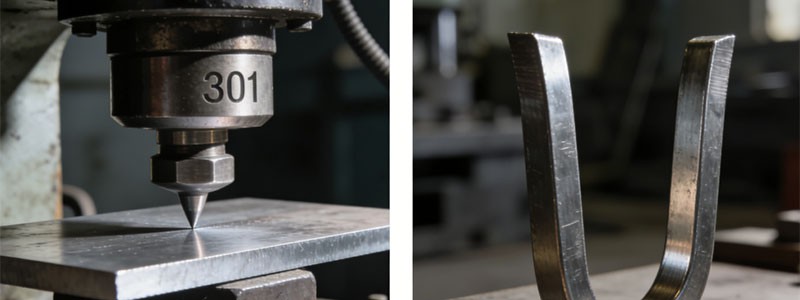
Different Application Scenarios:
301 Stainless Steel: High-load, cold-working dominated scenarios. Suitable for products with high strength requirements and mild corrosive environments. Typical applications include: train and aircraft parts, conveyor belts, bolts and springs, screens, pressure vessels, and hardware fasteners. Historically used in the liquid hydrogen tanks of the Atlas D rocket, its high strength is a testament to its advantages.
302 Stainless Steel: Mechanical Structures, Mild Corrosion Scenarios. Suitable for applications requiring a balance of strength, toughness, and corrosion resistance. Typical applications include: mechanical drive shafts, high-strength bolts, industrial valves, elevator components, medical device parts, and auxiliary components for food processing equipment.


