


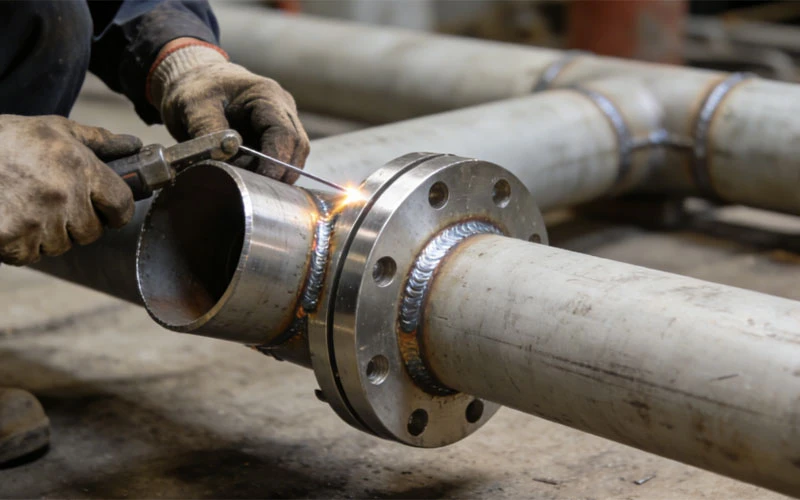
A socket flange is a special type of pipe connector. Its core design feature is a recessed socket at the inner diameter of the flange. During installation, the pipe end is inserted into this socket, and then fillet welds are made along the flange hub to form a robust connection. Unlike other flange types, socket flanges do not require complex beveling of the pipe; installation is completed through a simple insertion and welding process. They balance connection strength and sealing performance, making them widely used in medium- and high-pressure, small-diameter piping systems. Structurally, socket flanges are divided into necked and non-necked types. The necked type offers greater rigidity, less welding deformation, and superior sealing performance, suitable for pressures of 1.0~10.0 MPa. The non-necked type has a simpler structure and lower cost, making it suitable for low-pressure, small-diameter applications. They offer various sealing surface forms, including raised face, recessed face, tongue and groove, and ring joints, allowing for flexible selection based on media characteristics and pressure ratings to meet the sealing needs of different industries.

Why is the socket flange the preferred choice for small-diameter, high-pressure applications?
Easy and efficient installation, reducing construction costs: Pipes require no beveling; they can be directly inserted into the socket for welding. Installation speed is 30%~35% faster than weld neck flanges, making it particularly suitable for work in confined spaces. Simultaneously, the simplified construction process reduces the skill threshold for welders, lowering labor costs and significantly shortening the construction period for batch installations of small-diameter pipelines. According to industry data, using socket flanges can reduce the total installation cost of small-diameter pipelines by approximately 20%.
Excellent structural strength and high sealing stability: The double-sided fillet welds on both sides form a mechanical locking structure, providing outstanding resistance to bending and vibration. The damping coefficient is 40% higher than that of weld neck flanges, effectively suppressing vibrations caused by fluid pulsation. A pre-existing 1.5mm axial clearance between the pipe and the socket before welding reduces welding thermal stress deformation, lowering the risk of leakage. Sealing pressure can reach up to Class 3000, suitable for high-pressure systems ≥10MPa.
Smooth flow path, suitable for special media transmission: The integrated design of the socket and spigot ensures a smooth connection between the pipe and the flange inner wall, with no obvious protrusions. This reduces media flow resistance and turbulent corrosion, making it particularly suitable for conveying clean media and high-pressure steam, avoiding pipe blockage or corrosion problems caused by media stagnation.
Selection Contraindications and Precautions
To avoid pipeline failures due to improper selection, socket welding flanges are strictly prohibited in the following scenarios:
Slurry pipelines containing solid particles (particle diameter ≥ 0.3mm): Particles are prone to stagnation at the weld root, causing wear and blockage.
Thermal systems with frequent temperature cycles (cycles ≥ 5000 times) or temperature differences ≥ 150℃: The stress concentration factor at the weld root reaches 2.8, easily leading to fatigue cracks.
Highly corrosive media: The socket gap is prone to crevice corrosion, accelerating flange damage.
Large-diameter high-pressure pipelines (DN > 80): Welded flanges must be used to ensure connection strength.


