


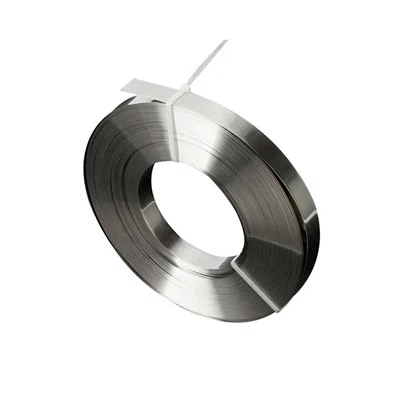
316Ti Stainless Steel Strips
Width: 5mm-850mm
Surface Finish: NO.1, 2B, HL, NO.4, BA, 8K, 9K, and as customers' request
Edge: Slit/Deburred/Round
Standards: ASTM 316Ti, JIS SUS316Ti, EN 1.4571
316Ti is a metal material, also known as Mo2Ti, which is created by adding titanium to SUS316 steel to improve resistance to intergranular corrosion. The titanium content is typically around 0.2% to 0.7%. Titanium atoms stabilize the structure of 316-grade materials at temperatures above 800°C, preventing carbide precipitation at grain boundaries and protecting the metal strip from corrosion.
316Ti stainless steel strip is widely used in the chemical industry where high acidic conditions prevail, and it is particularly effective in equipment that needs to resist sulfuric acid, phosphoric acid, and acetic acid.

Advantages of 316Ti Stainless Steel Strip
Heat Resistance
316Ti stainless steel strip remains resistant to carbide precipitation for longer periods at higher temperatures.
Similar Properties to 316
It retains similar physical and mechanical properties to standard 316 stainless steel strips.
Improved Corrosion Resistance
The addition of titanium to 316 stainless steel enhances its resistance to intergranular corrosion, making it ideal for use in high-acid environments.
Chemical Composition
|
Element |
Composition (%) |
Effect |
|
Carbon (C) |
≤ 0.08 |
Helps reduce intergranular corrosion |
|
Manganese (Mn) |
≤ 2.00 |
Has a certain effect on the mechanical properties of the alloy |
|
Phosphorus (P) |
≤ 0.035 |
|
|
Sulfur (S) |
≤ 0.030 |
|
|
Silicon (Si) |
≤ 1.00 |
Helps maintain the material's cold working properties |
|
Chromium (Cr) |
16.0 - 18.0 |
A key element for the corrosion resistance of stainless steel |
|
Nickel (Ni) |
10.0 - 14.0 |
Improves the alloy's corrosion resistance. |
|
Molybdenum(Mo) |
2.0-3.0 |
Enhances corrosion resistance. |
| Titanium(Ti) | 0.2-0.7 |
Improves resistance to intergranular corrosion. |
Performance
| Grade | Density | Thermal Conductivity | Thermal Expansion Coefficient | Electrical Conductivity | Yield Strength (YS) | TS | EL | HV |
| 316Ti | 8.0 g/cm³ | 16.3 W/(m·K) | 16.5 × 10^-6/°C | 1.25 × 10^6 S/m | ≥205 MPa | ≥520 MPa | ≥40% | Appr. 200 |
Application
Chemical Industry
Used in manufacturing corrosion-resistant chemical reactors, acid and alkali containers, and other equipment.
Petrochemical Industry
Suitable for high-temperature equipment in the oil and natural gas industries due to its high-temperature and corrosion resistance.
Medical Equipment
Frequently used in surgical instruments and implants due to its biocompatibility and corrosion resistance.
Marine Engineering
Ideal for hulls, valves, and ship sewage pipes due to its resistance to seawater corrosion.
High Temperature and High Pressure Environments
Used for high-temperature and high-pressure containers, furnaces, and heat exchangers due to its resistance to high temperatures and pressure.
Food Processing
Complies with food hygiene standards, making it suitable for food processing equipment and containers.
Processing
Processing and application of 316Ti stainless steel must adhere to relevant standards and best practices to fully utilize the material's properties.
Cutting: Use sharp tools to reduce cutting force. It is recommended to use tools with positive rake angles and large clearance angles. Coolant should be used during processing to reduce tool wear and work hardening.
Heat Treatment: 316Ti stainless steel can be enhanced through heat treatment, such as solution annealing and rapid cooling. The solution annealing temperature typically ranges between 1050°C and 1150°C, with water or air cooling methods.
Welding: Appropriate filler rods or welding rods should be selected to ensure the performance of the welded joint. Post-welding heat treatment may be required to relieve stress.
Forming: Due to the mechanical properties of 316Ti, forming operations should be conducted in the solution annealing state to ensure the material's plasticity and toughness.
Pickling: After hot rolling or welding, pickling may be required to remove surface oxide scale and dirt, ensuring surface finish and quality.
factory

Standards and Grades for 316Ti Stainless Steel in Different Countries
China Standard (GB-T): Digital grade S31668, new grade 06Cr17Ni12Mo3Ti, old grade 0Cr18Ni12Mo3Ti.
American Standard (ASTM): ASTM standard grade S31635, UNS standard 316Ti.
Japanese Standard (JIS): Standard grade SUS316Ti.
German Standard (DIN): Standard grade 1.4571.
European Standard (EN): Standard grade X6CrNiMoTi17-12-2.
French Standard (NF): Standard grade Z6CNDT17-12.
British Standard (BS): Standard grades 320S31 and 320S17.
Swedish/NTR Standard: Standard grade 23,432,350.
Hot Tags: 316ti stainless steel strips, China 316ti stainless steel strips manufacturers, suppliers, factory, different resources, stainless steel strips for operation, stainless steel flat strips, environmentally resistant stainless steel strips, precision stainless steel strips, stainless steel strips for waterproofing
Previous
2mm Stainless Steel StripYou Might Also Like




Send Inquiry