


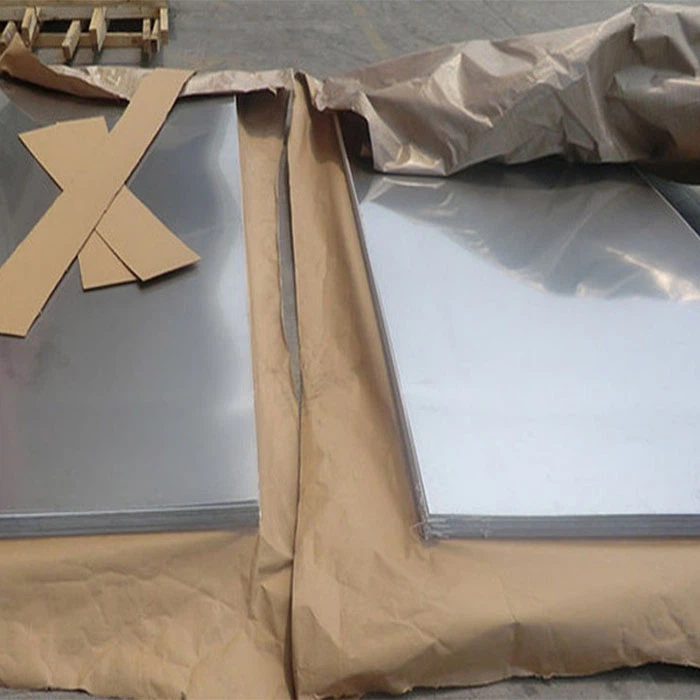
304 Annealed Stainless Steel Plate
what is 304 annealed stainless steel plate?
Annealing of stainless steel plates is a metal heat treatment process involving the gradual heating of stainless steel to a specific temperature, maintaining it at that temperature for a set period, and then cooling it at a controlled rate.
304 stainless steel is a widely used material known for its good corrosion resistance and processing performance, making it popular in manufacturing. However, processing can introduce stress into 304 stainless steel, affecting its performance and service life.
So, The purpose of annealing is to reduce hardness, improve machinability, eliminate residual stress, stabilize dimensions, reduce the tendency for deformation and cracking, refine grain structure, adjust the microstructure, and eliminate structural defects.
For example, the hardness of 304 stainless steel on a 2B surface after annealing is about HV205, while the hardness without annealing is generally around HV270. Excessively high surface hardness can lead to processing difficulties, particularly during calendering, and result in poor plate shape, thereby affecting the product's forming performance.


What is the annealing process of 304 stainless steel?
Complete Annealing
Used to refine the coarse microstructure of medium and low carbon steel after casting, forging, or welding, which improves its mechanical properties. The workpiece is heated to 30-50°C above the temperature where ferrite fully transforms into austenite. After holding at this temperature, it is slowly cooled in the furnace, allowing austenite to transform during cooling, leading to a finer grain structure.
Spheroidizing Annealing
Applied to reduce the high hardness of tool steel and bearing steel after forging. The workpiece is heated to 20-40°C above the austenitizing temperature, followed by slow cooling. During cooling, lamellar cementite in the pearlite transforms into spheroidal shapes, reducing hardness and improving machinability.
Isothermal Annealing
Used for alloy structural steels with high nickel and chromium content to reduce hardness for easier machining. Austenite is cooled rapidly to a specific temperature, held for an appropriate time, and then transformed into bainite or sorbite, reducing hardness.
Recrystallization Annealing
Eliminates the hardening effect from cold working processes such as drawing and rolling, restoring ductility. The metal is heated to 50-150°C below the austenitizing temperature, allowing recrystallization to occur, softening the metal and eliminating work hardening.
Graphitization Annealing
Converts cementite in cast iron into malleable graphite, improving plasticity. The casting is heated to about 950°C, held for a set period, and then cooled properly, leading to the decomposition of cementite into flocculent graphite.
Diffusion Annealing
Homogenizes the chemical composition of alloy castings, enhancing performance. The casting is heated to a high temperature just below the melting point, held for an extended period, and then slowly cooled, allowing diffusion of elements to achieve uniform distribution.
Stress Relief Annealing
Reduces internal stresses in steel castings and welded parts. The steel is heated to 100-200°C below the austenitizing temperature, held for a time, and then air-cooled, which alleviates internal stress without significantly altering the microstructure.
annealing process
Annealing operation
The stainless steel plates or strips are annealed at a temperature between 900°C and 1000°C for a duration of 1 to 3 minutes, with a processing speed of 40 to 70 meters per minute (mpm).
Physical phosphorus removal
The surface oxide scale of the annealed steel strip is removed through a physical dephosphorization process. Initially, the dephosphorization machine stretches the steel strip by 0.5±0.2%, allowing the surface oxide scale to detach from the stainless steel matrix. This is followed by the shot blasting process, where the shot blasting wheel projects abrasive material onto the strip's surface, effectively removing the remaining oxide scale. After shot blasting, the steel strip proceeds to the pickling process.
Hot Annealing and Pickling Operation
Following physical dephosphorization, the strip steel undergoes pickling to produce white stainless steel coil products.
Cold Rolling and Re-Pressing Operation
The pickled strip steel is cold rolled 5 to 13 times through a cold rolling unit, achieving a final rolling thickness between 0.3mm and 6.0mm.
Cold Annealing and Pickling Operation
After the cold rolling and re-pressing operation, the strip steel is continuously annealed at temperatures ranging from 1100°C to 1200°C for 1 to 3 minutes. It then undergoes electrolysis, followed by pickling with a cold annealing mixed acid to produce the final re-pressed product.
Final Product Performance:
Yield Strength: 200N/mm² to 350N/mm²
Tensile Strength: 600N/mm² to 800N/mm²
Hardness: HV 150 to 200
Metallographic Grade: 7.0 to 9.0
The product's corrosion resistance and formability comply with the required standards.
Certifications
We are a partner you can trust to provide the perfect solution for all your stainless steel needs.

QMC

EMC

OHSMS

SGS

SGS

TEST REPORT
Hot Tags: 304 annealed stainless steel plate, China 304 annealed stainless steel plate manufacturers, suppliers, factory, 200 series stainless steel sheet, 316 stainless steel sheet, 316ti stainless steel sheet, 400 series stainless steel sheet, 409 stainless steel sheet, 410 stainless steel sheet
You Might Also Like


Send Inquiry